
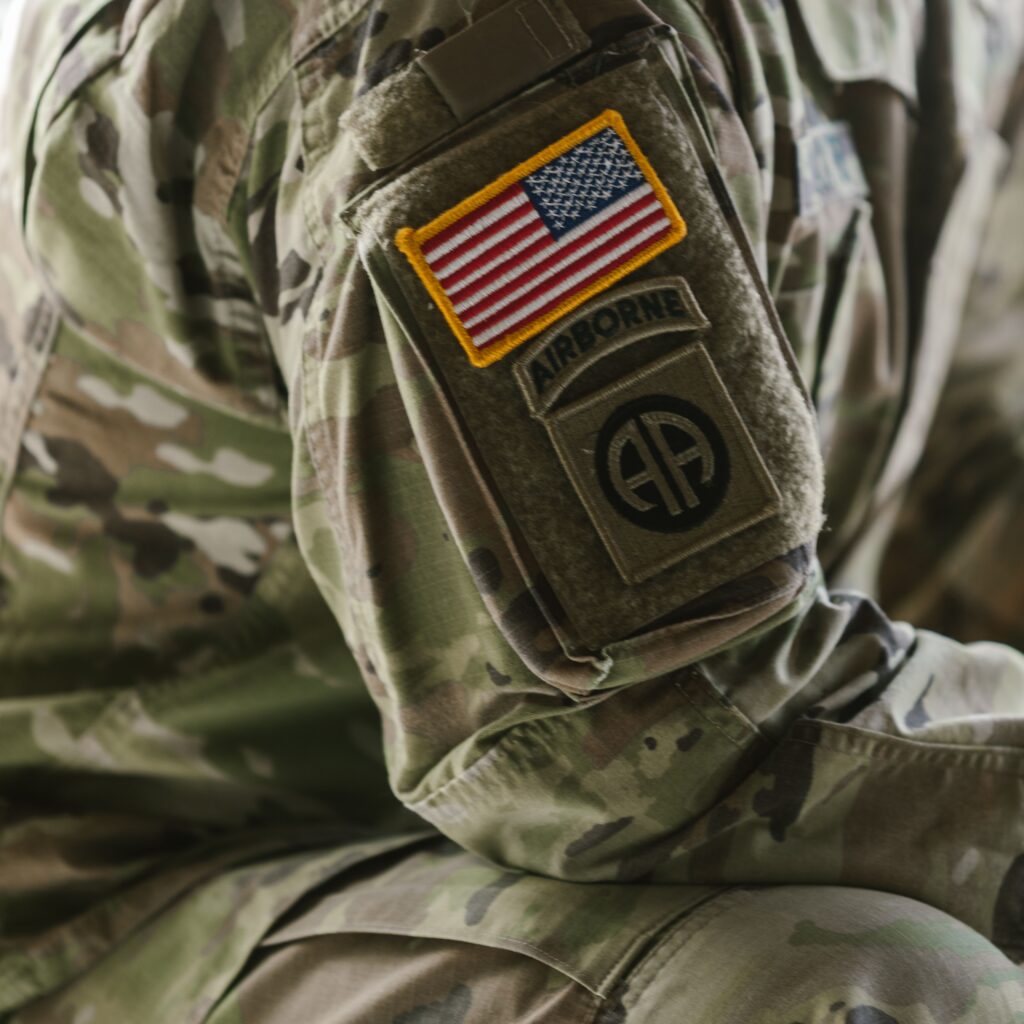
The uniforms worn by America’s service members are far more than fabric. Military uniforms today provide concealment and protection from both environmental and combat hazards. In addition, they help identify combatants and promote organizational discipline and unity. In America, all six military branches have their similarities and differences. The colors, materials, technology, and details of that uniform holds a significant symbol of what the United States represents.
Practical Design of military uniforms
Uniforms used to be bright colors so that units could identify each other through heavy smoke, but the bright uniforms soon became lethal since smokeless gunpowder became popular. Prompting the adoption of khakis and olive drab uniforms. Since wearing bright colors made you a target, wearing warmer tones became the safer option. The colors and materials used on the uniform are essential to the soldier’s safety and comfort.
For geographical and protective reasons, certain uniforms are engineered with special coatings to resist infrared detection, reduce flame hazards, and protect against chemical, biological, radiological, and nuclear threats.
According to the U.S Department of the Army, “uniforms have evolved to match military tactics and technology – with warfighters constantly equipped with gear that increases survivability, mobility and lethality.” To provide comfort, most uniforms use a blend of cotton and synthetic fibers for durability and breathability without adding heavy weight. Cut and designed to allow for a wider range of motion and to make it as accessible as possible to comfortably carry equipment.
Colors vary depending on the environment. In a jungle, the colors used for uniform would be deep greens, browns and blacks to prevent a silhouette in densely vegetated areas. Desert uniforms are lighter earth tones, tan and sand colors to blend in with rocky or sandy regions. For multi-environment purposes (OCP), the Operational Camouflage Pattern that the U.S. The Army’s primary uses are camouflage patterns. A mix of browns, tans, and light green is used to enhance effectiveness across varied terrain. Pixelated patterns are used on uniforms to confuse the human brain’s visual processing at varying distances. All to ensure the soldier’s safety..
Symbolism
Military ranks exist to display a service member’s level of authority, command, and responsibility within the hierarchical chain of command. Qualifications, combat, and identification badges are specialized emblems worn to designate specific professional accomplishments, participation in hazardous duty, or advanced training.
According to the U.S Army, ranks are “More than an indication of pay grade, Army ranks provide a system of leadership that indicates a Soldier’s level of expertise, responsibility, and authority inside that profession. Regardless of rank, every Soldier has a significant role in the total Army mission.” Depending on which military branch, colors and styles may differ.
The Six U.S. Military Branches
- The U.S Army – Army Green Service Uniform and the traditional Blue Army Service Uniform.
- U.S Marine Corps – Dress Blue Uniform that features the iconic red “blood stripe” on the trousers.
- U.S Navy – Service Dress Blue for fall/winter and service Service Dress White for spring/summer.
- U.S Air Force – ultramarine blue service uniform with a sleek jacket and silver accents.
- U.S Coast Guard – deep Blue Service Uniform and a unique Combination Hat.
- U.S Space Force – dark, sleek uniforms with silver-grey threading and delta-shaped rank insignia that add to its modern identity.
Military uniforms blend function and meaning, making them essential tools and symbols of military service. To ensure the safety of the person fighting to protect the union, both the colors and materials must be chosen precisely. Now do you see why a military uniform is more than just a piece of clothing?
To learn more, visit the Ferry Godmother Productions!