
What happens when a woman in uniform trades her hometown for a battlefield thousands of miles away?
During World War II, thousands of members of the Women’s Army Corps (WAC) served overseas, taking on vital support roles that significantly contributed to the war effort and ultimately helped win the war. They worked in Europe, the Pacific, and North Africa, proving that service, skill, and strength were not limited by gender (source).
From America to the Front Lines
The first WACs began deploying overseas in 1943, serving in the United Kingdom, North Africa, France, and the Pacific. Their work was crucial to maintaining communication, logistics, and operations throughout the Allied campaigns (source).
Most WACs stationed abroad performed administrative duties, communications, or supply coordination. Others worked as weather observers, radio operators, control tower assistants, or mechanics. Their professionalism quickly earned them respect among commanders, who saw how efficiently they could keep operations running under pressure.
By the end of the war, 565 WACs received the Bronze Star for meritorious service overseas, and hundreds more earned medals and citations for excellence (source).
The 6888th: “No Mail, Low Morale”
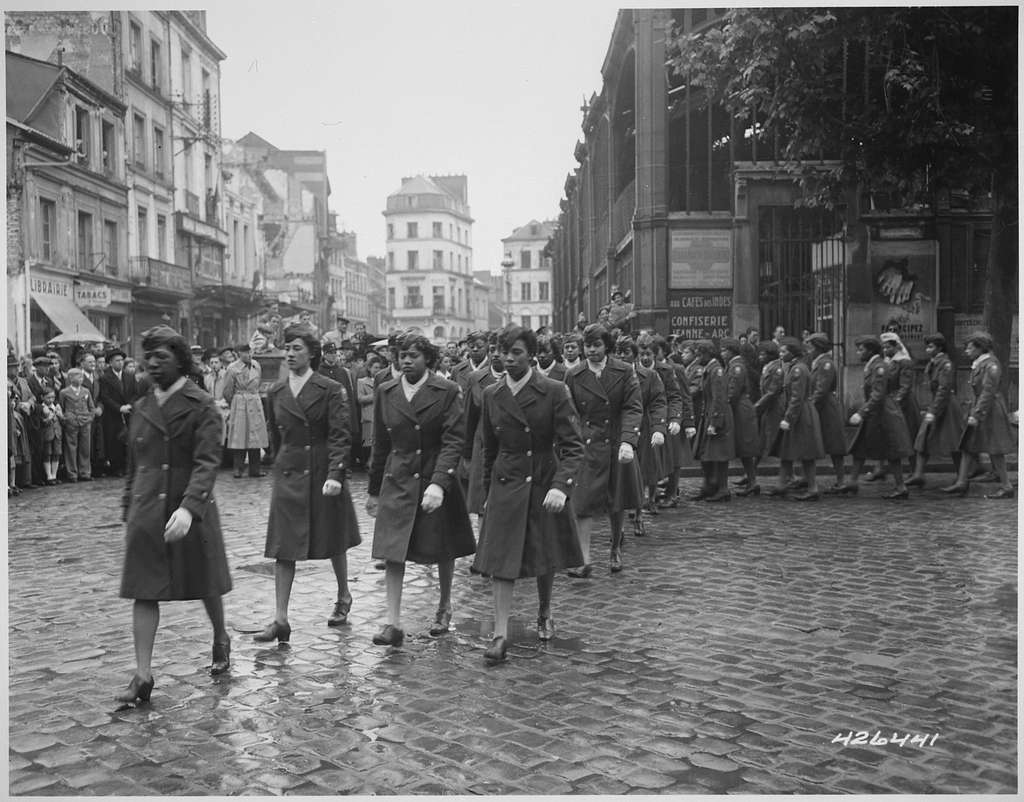
Among the most remarkable WAC units abroad was the 6888th Central Postal Directory Battalion—the only all-Black, all-female unit deployed overseas during World War II.
Stationed first in Birmingham, England, and later in Rouen and Paris, France, the 6888th processed a backlog of over 17 million pieces of mail for American troops in just three months—half the time expected. Working around the clock in cold, dim warehouses, their motto became “No mail, low morale” (source).
Despite harsh conditions and segregation in the military, the women of the 6888th proved indispensable to the morale and logistics of the soldiers. They returned home to Fort Dix, New Jersey, in 1946, where the unit was officially disbanded (source).
WACs at Allied Headquarters
Other WACs served in Europe with General Dwight D. Eisenhower’s Allied headquarters, managing classified communications and logistical coordination. Among them was Dorothy L. Starbuck, who held top-secret clearance and later became one of the highest-ranking women in the Veterans Administration (source).
Returning Home: Legacy and Change
When the war ended, WACs returned to a nation still adjusting to women’s expanded roles. Many found their wartime skills undervalued in civilian life. Yet their contributions reshaped expectations of women in uniform. Their work overseas demonstrated competence under pressure and paved the way for full integration of women into the U.S. Army in 1978 (source).
Conclusion: Beyond Borders, Beyond Expectations
The women of the WAC who served overseas played a crucial role in sustaining the Allied victory through their dedication, precision, and resilience. From Birmingham to the beaches of Normandy, their service extended America’s strength beyond its borders.
Their story reminds us that leadership and courage aren’t defined by combat—but by commitment to purpose, wherever duty calls.