
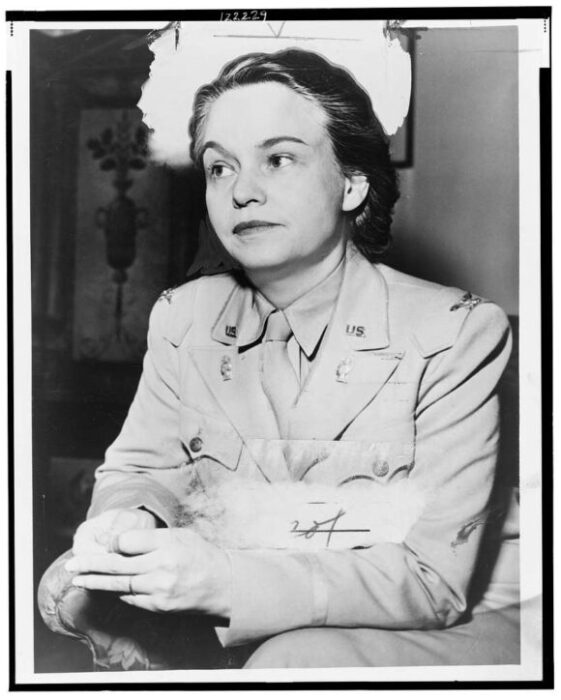
Oveta Culp Hobby broke barriers when she led the Women’s Army Corps. That corps proved that women could serve with professionalism and patriotism. Her leadership shaped how women fit into the U.S. military and later into federal service. Her story holds lessons about courage, equality, and public service for all communities.
Early Years and Rise to Military Leadership
Oveta Culp was born in Killeen, Texas, in 1905. She worked in journalism and public service, including as a parliamentarian of the Texas House of Representatives. In 1941–42, she joined the War Department as head of the Women’s Interest Section. When Congress created the Women’s Army Auxiliary Corps (WAAC) in May 1942, she became its first director. Hobby told her recruits, “Women who step up and do their part are not just helping the war, they are helping the future” (National Women’s History Museum). In July 1943, the WAAC became part of the U.S. Army as the Women’s Army Corps (WAC), and Hobby was commissioned a colonel.
Leadership During World War II
As director of the WAC, Hobby oversaw recruitment, training, and standards for conduct. She emphasized uniforms, discipline, and the image of soldiers over “helpers.” The WAC included women serving in many non-combat roles—clerks, telephone operators, drivers, and others. For her service, she received the Distinguished Service Medal, becoming the first woman in the U.S. Army to earn the award.
From Military to Cabinet: Expanding Her Impact
After World War II, Hobby returned to Houston and worked at the Houston Post newspaper. In 1953, President Dwight D. Eisenhower appointed her head of the Federal Security Agency, then elevated it to the new Department of Health, Education, and Welfare. She became the first Secretary of Health, Education, and Welfare. During her tenure, she helped oversee national public health initiatives, including the approval of the polio vaccine. Hobby resigned in 1955 and resumed her civic and business work in Texas.
Conclusion
Oveta Culp Hobby remains a model of what leadership with purpose and integrity can look like. She guided the Women’s Army Corps when few believed women could serve in such roles. She then took what she learned into the highest levels of government. Her legacy encourages us to keep opening doors for everyone in public service.
To learn more stories like this, or connect with communities who share this history, visit us at Ferry Godmother and explore the Ferry Godmother Blog.